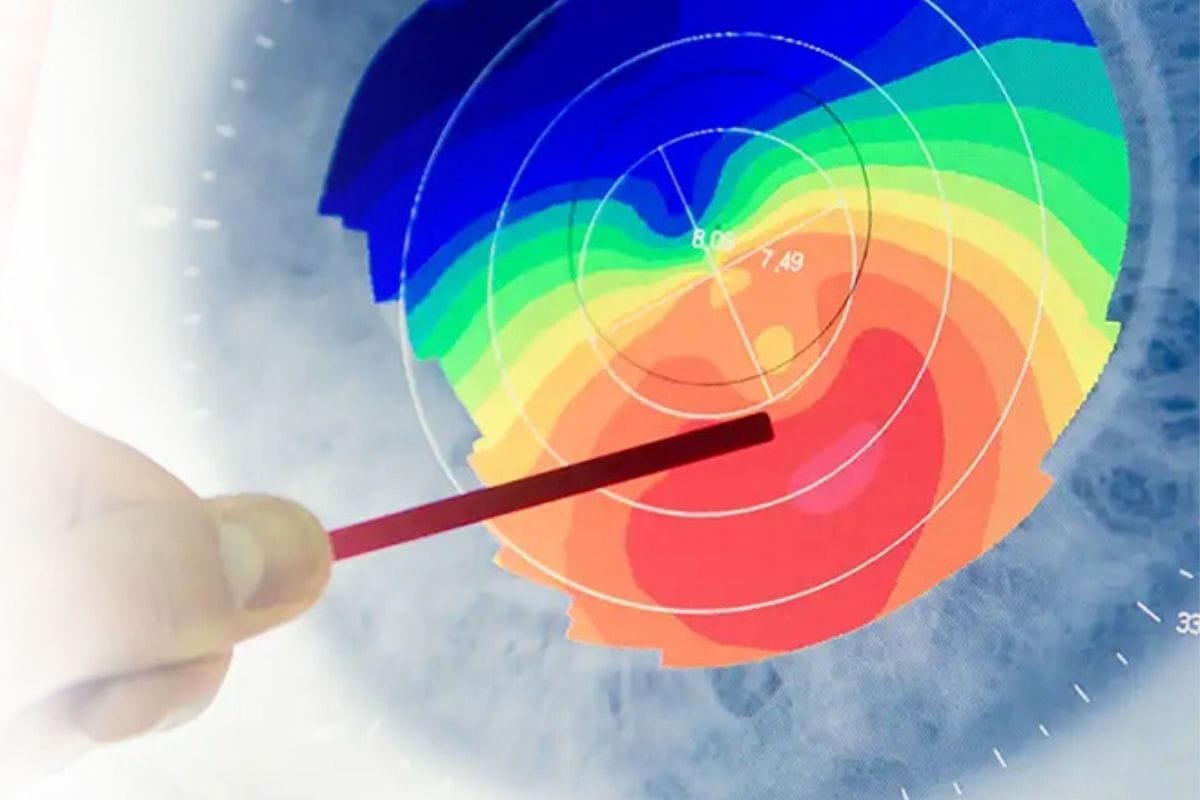
Laser topography is an advanced measurement method that analyzes the structure of the cornea, that is, the front surface of the eye, down to the finest details. The device creates a three-dimensional corneal map (corneal topography) by scanning the cornea from thousands of points.
Why is Laser Topography Done?
- Removing a corneal map before laser eye surgery
- Evaluation of refractive errors such as myopia, astigmatism and hyperopia
- Investigation of suspected keratoconus and irregular astigmatism
- Monitoring the effects of contact lens use on the cornea
- Planning before treatments such as corneal transplant or cross-linking (CXL)
- Follow-up of recovery after laser surgery
How is Laser Topography Done?
The patient sits in front of the device and looks at a fixed point inside. The corneal surface is scanned with laser light and data is collected from more than 25,000 points. The collected data is converted into a three-dimensional colored corneal map in a computer environment. On the map, red areas represent steepened areas and blue areas represent flattened areas. The procedure only takes 10-15 seconds and is completely painless and contactless.
Pre-Test Preparation
Patients using contact lenses: soft lenses should be removed at least 2 days before the test, and hard (RGP) lenses should be removed 1 week before the test. This period allows the cornea to return to its natural form and increases measurement accuracy.
Benefits of Laser Topography
- Allows identification of safe candidates for laser surgery
- Detects conditions requiring early diagnosis such as keratoconus
- Shows irregularities in the cornea with micron precision
- Contactless, fast and completely painless
Frequently Asked Questions
Is laser topography mandatory before laser surgery?
Yes. Laser topography is one of the most critical tests that determine suitability for laser surgery. Detection of inappropriate corneal structure protects the patient from possible risks.
What is the difference between laser topography and Pentacam?
Both perform corneal topography. Pentacam also evaluates the back surface and provides more comprehensive data. Laser topography is particularly powerful in surface curvature mapping.
Can laser topography be performed while wearing contact lenses?
No. Contact lenses temporarily change the shape of the cornea. It is necessary to wait 2 days for soft lenses and 1 week for hard lenses.